Is carpooling with strangers safe? An honest answer
What TAGO checks before you get in a car — .edu sign-in, ratings both ways, scan to start — the four things it does not, and what works in any car.
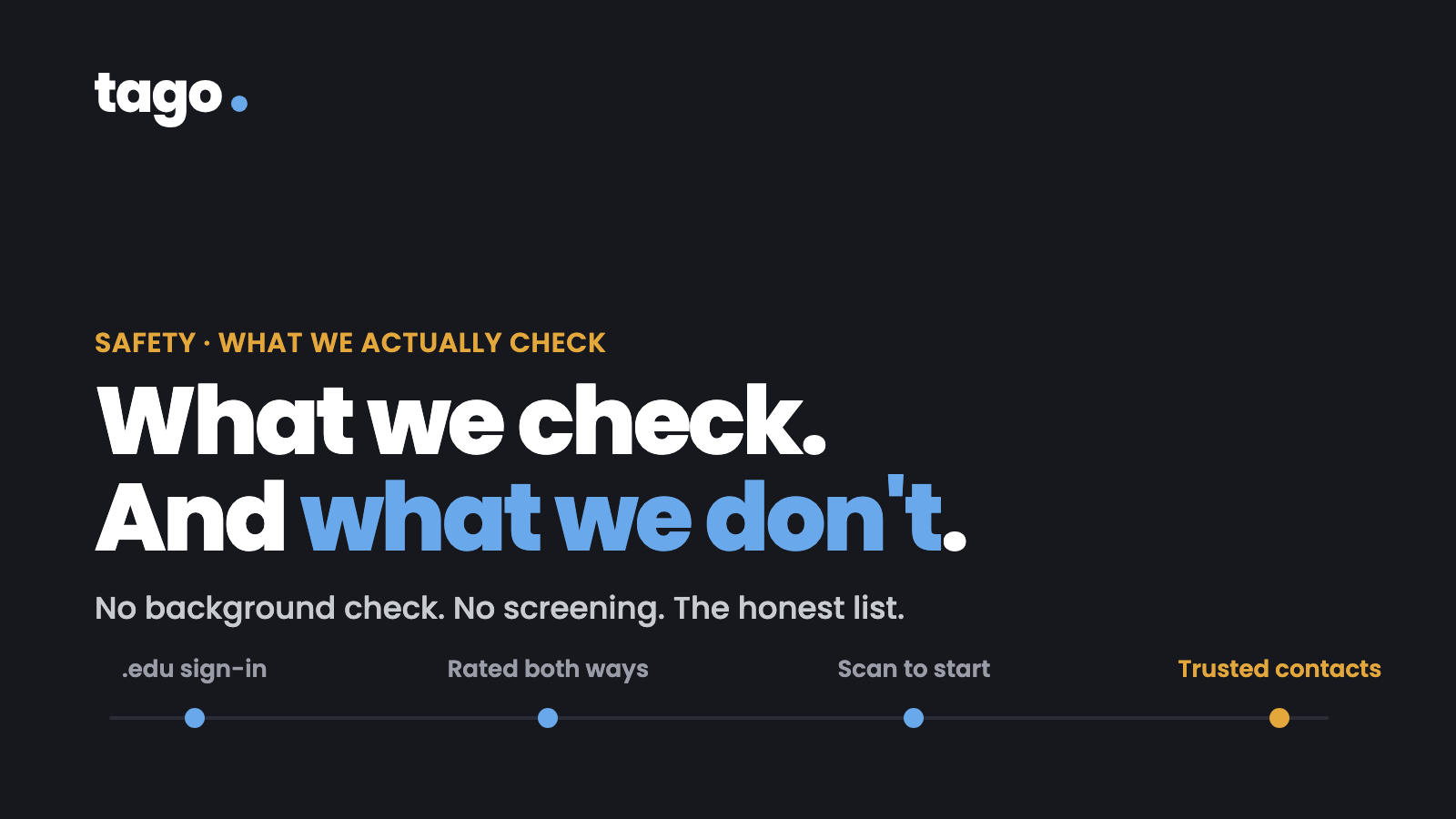
The first question anyone asks about TAGO is the same, and it is the right one. Get in a car with someone I have never met?
Safe is not a property an app has. The answerable questions are narrower: who is in the pool, what is recorded while the trip runs, who else knows where you are. So: what we check, what we don't, and what lowers the risk in any car.
Seven things that work in any car
These cost nothing, and work whether or not you install anything.
- Match the car before you open the door. The federal advice for any pre-arranged ride is to check the licence plate against what you agreed, look at the driver and ask their name — many of these cars look alike (NHTSA, Ways to Get Home Safely). Ask who they are here for. Don't supply the answer yourself.
- Tell one person the plate and the time. A screenshot to somebody who would notice if you never arrived is the cheapest safety feature there is, and no app is needed to send it.
- Share the trip while it is running. Both phone systems can share your live location with a contact. Turn it on when you get in, and leave it on until you are through the door at the other end.
- Wait somewhere lit and public. NHTSA says to pick a spot where you can wait indoors, and failing that somewhere well lit and away from the roadway. UC Davis police say the same about getting to the spot: well-lit, populated routes, and avoid secluded ones at night (UC Davis Police, Safety Tips). If the walk to the meeting point is the sketchy part, the campus Safe Rides service is free — check its hours first.
- Sit where you can get out, and put the belt on. The UC Davis list has a line about noticing your exit options, which is worth applying to a back seat. NHTSA is blunt about the belt: buckle up even in the back, even on a short ride.
- Agree the drop point before you leave. This matters most on a long corridor. Davis to San Francisco on TAGO is a couple of hours, and "the city" is not a drop point. Name a cross street. NHTSA says the same from the other side: ask to be dropped somewhere safe, not just somewhere convenient.
- Keep the conversation in one place. One thread, not half in DMs and half over the phone. There is then a record of what was agreed, and you are not rebuilding the plan from three apps at 11pm.
The one that overrides all seven: if something feels off, do not get in. UC Davis police put trusting that instinct on their own list, and a trip you walked away from costs you a wait.
What TAGO checks
What TAGO does about safety, as a carpool between students:
.edu sign-in. The .edu verified badge means one narrow thing: that account's address
ends in .edu, and the address itself never leaves the server. It says which pool you are
in, not who is in it.
Rated both ways. A rating stores who rated and who was rated, either side either role. Riders rate drivers; drivers rate riders.
Scan to start. You scan the driver's code, or type its six digits, to start the trip. Signed, good for one trip day, so an old screenshot starts nothing.
Trusted contacts. Saved once, when nothing is wrong. The help button hands them back with a link to the live trip.
A mid-trip check. If the two phones drift apart, both sides get a prompt: still here, I got out, or help. No answer, and the trip ends itself ninety seconds later.
Reports go to a person. Reporting someone opens a thread a human reads and replies in.
Names stay private until you sign in. A public trip link gives a city-level corridor, a
date, seats, and four facts: school, rating, trips completed, .edu or not. Never a name,
a photo, an address, a plate or a coordinate. Signing in is the trade, both ways.
What TAGO does not check
We do not check driving licences. We do not run background checks. We do not check insurance. We do not screen or approve drivers — no interview, no waiting list, nobody at this end deciding someone is a safe person.
That is a position, not an oversight. We are not a service with approved staff; we are students driving their own cars on trips they were making anyway. A check we could not perform properly would sell you a badge instead of safety — which is why our server bans vetted, screened and insured from a driver's description.
What works instead is who is in the pool, and that nothing in a trip is anonymous: both people rated afterwards, both ratings visible to whoever comes next, a report that reaches a human. Nobody rides with a stranger because of that — not because anyone was cleared by us.
None of it promises a car is going your way on a given day — that depends who is going, so post early. What you chip in is its own subject: how ride costs split. Or sign in with your .edu and see what is posted on your route.
The checklist
- Tell one person the plate, the name and the time you should arrive.
- Check the plate. Ask the driver who they are here for, before you open the door.
- Share your live location until you are inside at the other end.
- Meet somewhere lit and public. Sit where you can get out. Belt on.
- Agree the exact drop point before you leave, not on the freeway.
- Keep the conversation in one thread.
- If it feels wrong, do not get in. You lose a wait, nothing else.