How the cost of a ride gets split on Tago
What you chip in per seat, the IRS ceiling on it, why long trips cost less per mile, and why there is no commission and no booking fee.
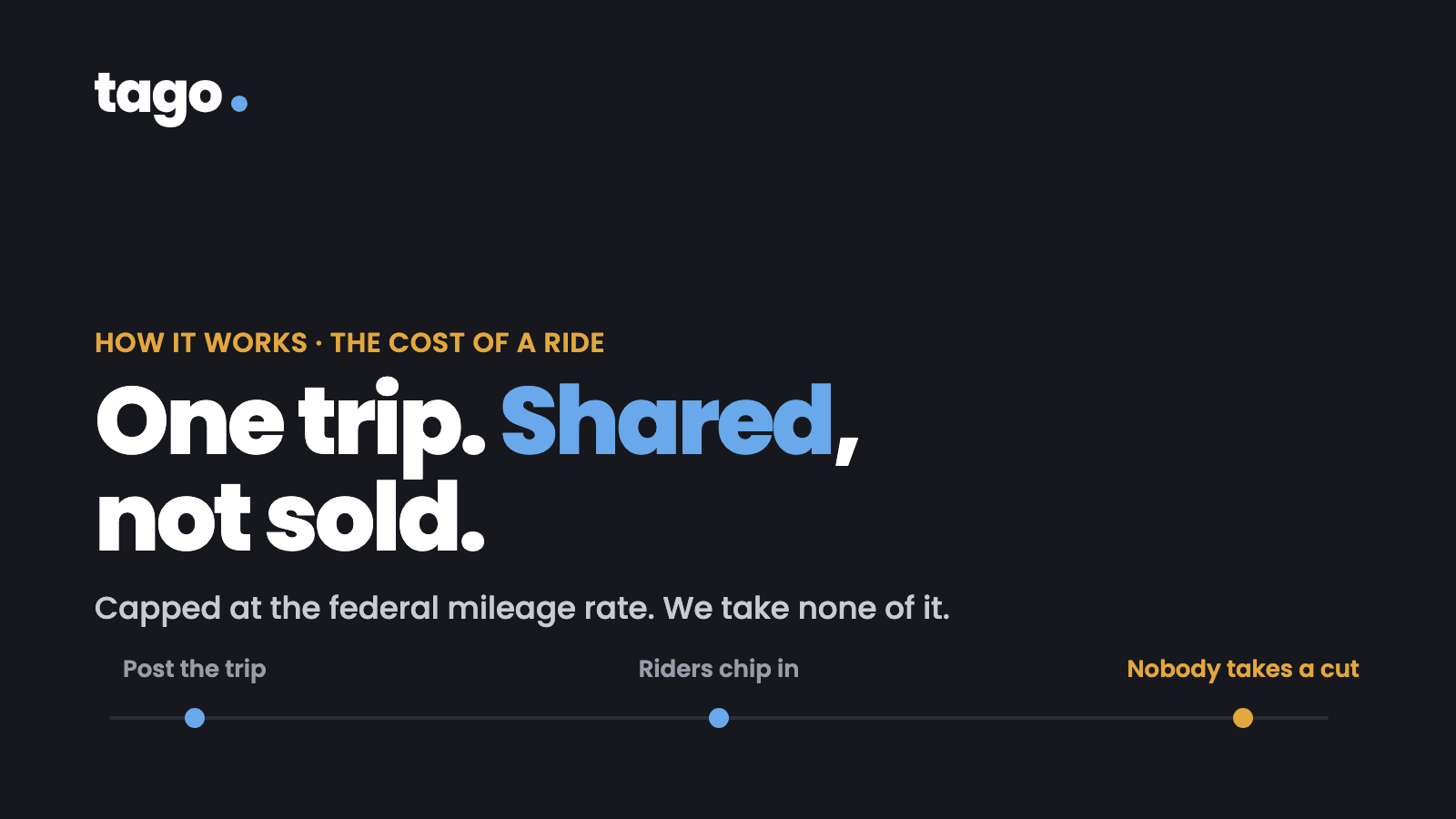
If you have only ever used a ride-hailing app, the answer to "what does this cost?" is a number somebody set. A carpool works differently. There is a trip that was already happening, a car with empty seats, and a cost that gets divided among the people in it.
This is how that division works on TAGO, a carpool app for college students — what you chip in, what caps it, what we take out of it, and what lands on your card.
Riders chip in per seat
Every rider has their own share, worked out from their own miles: where you got in, where you got out. Two people in the same car going different distances do not contribute the same amount, and neither of them is buying a service.
The driver's side is the mirror of that. They are not selling seats. They are recovering part of the cost of a trip they were making anyway. Everything below follows from that one structural fact.
Your share has a ceiling, and it is the federal one
There is a hard cap on what a rider can contribute: the IRS standard business mileage rate for the day of the trip, times the miles.
Two things are worth pulling out of that sentence.
First, it is a ceiling, not a rate card. What you actually chip in usually lands under it — the taper below is why.
Second, "for the day of the trip" is doing real work. The IRS rate is effective-dated and can change mid-year; 2026 has two of them. In the code the rate belongs to the trip date, never to the moment the arithmetic happens, so a trip driven in June settles at June's rate even if the money moves in August. That is also why there is no cents figure on this page: whichever one we printed would be wrong for some trips.
That rate exists to cover what a car actually costs to run — maintenance, depreciation, insurance, wear. It is not an estimate of one tank. And because it is a ceiling on cost recovery rather than a floor on cost recovery, the arithmetic cannot leave a driver ahead. Nobody's making a profit. That's the point.
The per-mile rate eases after eight miles
Each rider's first eight miles are charged at the full rate. Past eight, the per-mile rate eases downward toward a floor set well below it. So a long trip costs less per mile than a short one — the twentieth mile is cheaper than the second.
It is applied piecewise on purpose. The easing only ever touches the miles past the first eight, which keeps the total honest in both directions: a longer trip can never come out cheaper overall than a shorter one.
You see an estimate before you commit, computed by the same engine that does the real arithmetic. The final amount is worked out from the distance actually driven, so it moves if the trip does.
What TAGO takes: 0%
The platform fee rate in the code is the number zero. That is not a launch promotion with an expiry date buried in a settings screen; it is a constant that every settlement is measured against.
Every settlement runs an invariant check: what the rider contributed has to equal what goes to the driver plus the platform fee, exactly. If those two ever disagreed the trip would throw an error rather than quietly move a wrong number. With the fee at zero, that check is really asserting that the whole of your share reaches the person who drove.
No commission. No booking fee. No service fee on a trip. Joining, posting and searching cost nothing at all.
The card fee, said plainly
There is one number that is not ours, and we are not going to pretend otherwise.
When your card is charged, the card processing fee is added on top of your share at checkout, and you cover it. It goes to Stripe, our payment processor, not to us — the charge is grossed up so that TAGO nets exactly your share and not a cent more. Trip summaries show you the total with that fee included rather than a bare share and a footnote.
Who is actually in the car
You sign in with your .edu email. The .edu verified badge you see on a post is derived
from the domain of that address — the address itself never leaves the server.
That badge means one thing and claims nothing more: a university email. It is not a background check and we do not describe it as one. What sits alongside it is a rating from every trip a person has taken, in both directions, because riders rate drivers and drivers rate riders.
One line on points
Every completed trip collects Tago Points — one per mile, capped at 50 a trip, and never fewer than one. 100 points is $1 off a future trip. Riding or driving, it is the same arithmetic.
The short version
Your share is per seat and per mile. It cannot exceed the federal mileage rate for the day you travelled. It eases down past the first eight miles. We take nothing out of it, and the only thing added to it is the card fee, at checkout, shown to you.
If you want to see the model with an actual trip attached, two worked examples: getting to Aftershock from Davis and landing at SFO with a term's worth of luggage. Or sign in with your .edu and look at what is posted on your own route.